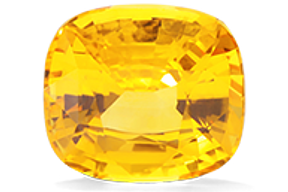
Yellow Sapphires
The most common cause of the yellow coloration in a sapphire is the trace element iron. Typically speaking, increased iron concentrations will also increase color saturation. Yellow sapphires can also be colored naturally by low-level radiation within the earth or by lab-induced irradiation. Gemstones that obtain their color through irradiation have been known to fade with exposure to heat and light. Heat treatments have vastly increased the supply of yellow sapphires on the market today. Unheated yellow sapphires with strong saturation remain quite rare.
Yellow sapphires frequently have fewer inclusions than other sapphire colors and are held to higher clarity standards than other sapphire colors. The trace element titanium may cause an undesirable green cast in yellow sapphires, which makes the most valuable gemstones those that are relatively titanium-free. (The titanium-bearing rutile silk is less common in fine yellow sapphires than sapphires of other colors.) Yellow sapphire’s transparency and clarity are paramount to the value of the sapphire.
Yellow sapphire rough has traditionally been less costly than blue, pink, or Padparadscha (a mixture of pink and orange), so cutters are more reluctant to compromise brilliance in favor of weight retention. As a result, well-cut yellow sapphires are easier to find than other sapphire colors. (Yellow sapphires are also more likely to be available in specialty cuts, such as radiant cuts, which enhance the color of the gemstone.)
Yellow sapphires are found in Tanzania, Madagascar, Thailand and Australia, although Sri Lanka is the primary source.