Diamond Anatomy
While every diamond is unique, all diamonds share certain structural features. A diamond’s anatomy, or its basic structure, determines its proportions, brilliance, dispersion and scintillation. Each part of the diamond has a specific name, and having a basic understanding of how each part contributes to the diamond as a whole will help you find your perfect diamond.
A diamond is comprised of eight main components. They are Diameter, Table, Crown, Table Spread, Girdle, Pavilion, Depth, and Culet. Below is a brief description of each part of a diamond and its location.
Diameter: The width of a polished stone, measured from edge to edge.
Table: The largest polished facet located on the top of the diamond.
Crown: The top part of a diamond extending from the table to the girdle. The crown is made up of bezel facets (crown mains), star facets, upper girdle facets (upper halves), and a table facet.
Girdle: The very edge (widest edge) of the diamond where the crown and pavilion meet.
Pavilion: The bottom part of a diamond extending from the girdle down to the culet.
Depth: The total height of a diamond measured from the table to the culet.
Culet: The small or pointed facet at the very bottom of the diamond.
Before purchasing a diamond, make sure that you have a basic understanding of a diamond’s anatomy. This will allow you to truly appreciate diamonds and all their intricacies, communicate with experts about a particular diamond, and, most importantly, it will assist you in making a well-thought out decision about which diamond is best for you.
Proportion – Understanding Brilliance, Dispersion & Scintillation
Well–proportioned diamonds exhibit three different properties: brilliance, dispersion and scintillation. As light strikes a diamond's surface, it will either reflect off the table of a polished stone or enter the diamond. The light that is reflected is known as the diamond's brilliance — the flash of white light one sees when looking at a stone. As light travels through a stone, some of the light rays are separated into flashes of color. This is known as dispersion. The result of dispersion—the separation of white light into its spectral colors — is known as fire. Scintillation is flashes of color that are viewable as an observer moves a diamond back and forth.
Putting It All Together
Use this interactive tool to see how depth and table percentages can affect the brilliance in a round diamond. Please Note: this example is for a round diamond only—fancy shapes have their own set of unique properties.
Diamond Symmetry
Symmetry refers to the exactness of the shape and arrangement of facets in a diamond. Although to the naked eye finish features only have a tiny effect on appearance, symmetry is significant. In diamonds that have low clarity grades, symmetry is less important, but in diamonds with very high clarity grades, symmetry is very important.
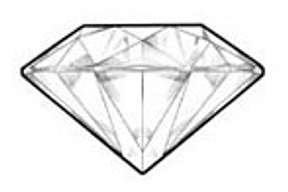
Wavy Girdle
The girdle of a diamond should be a flat plane, parallel to the table. In this example the girdle "waves" as it wraps around the diamond.
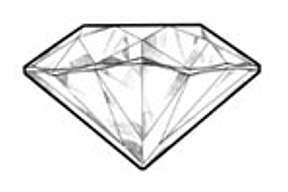
Crown & Pavilion Misalignment
In a round diamond the top points of the pavilion mains and the bottom points of the bezel facets should meet precisely at the girdle. We can see in this example the diamond's crown and pavilion facets are misaligned.
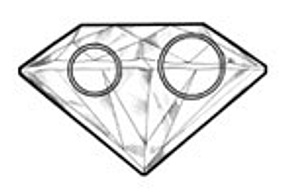
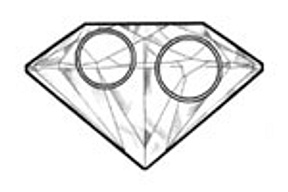
Extra Facets
These are typically located on the pavilion, near the girdle, but they can be found anywhere on a diamond. In this example we see where extra facets commonly occur.
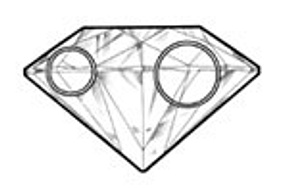
Off-Center Culet
To check if the culet is centered, look at the diamond in the face-up position. You'll see the lower girdle facets through the table. If the lines formed by them look like a perfect square, the culet is centered. If the cross bends one way of the other, the culet is not centered. In this example we see what an off-centered culet might look like.
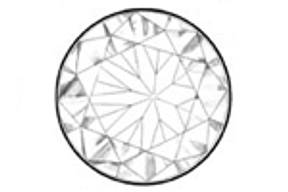
Off-Center Table
The placement of the table (the largest facet on a diamond) should be centered at the top of the stone and needs to be parallel to the girdle. If the table is off-center or not parallel with the girdle this can cause uneven crown angles from one side to the other. In this example we see the unbalanced appearance that occurs from an off-center table.
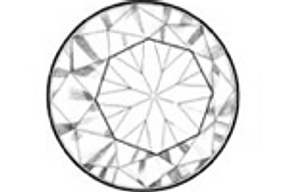
Table & Girdle Not Parallel
Here we see another example of what occurs when the table is not parallel with the girdle. As you see, the crown angle is much steeper on one-side than the other. From the top view you may have noticed an off-center table.
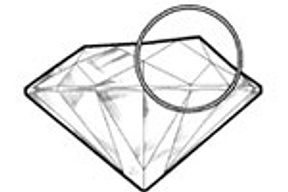
Misshapen Face
A correct table displays a regular octagon shape. It should have eight sides of equal length that are each parallel to the opposing opposite facet. In this example we see facets that are not properly shaped, or they are not the same size and shape as others like them on the face of the diamond.
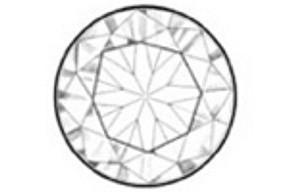
Faces Not Pointing Up
Some diamonds display facets that are not properly pointed. Facet patterns of round brilliants are meant to show a precise arrangement of 58 perfectly shaped facets. In this example we see some that some do not meet at a direct point.
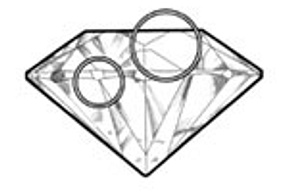
Naturals on Crown and Pavilion
A natural is the original "rough" of the diamond. Naturals always occur or start out on the girdle. They either dip towards the pavilion or the crown. In this example we see the natural located on the girdle running down into the pavilion.
Diamond Polish
What Is Diamond Polish?
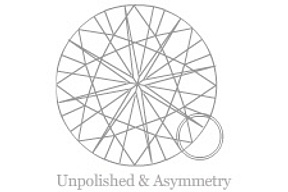
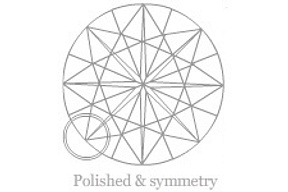
Diamond polish influences how well light is able to pass through a diamond. It is a very important attribute in determining a diamond's overall brilliance. When choosing a diamond, it is best to pick one that is laboratory certified with good, very good or excellent polish. Diamonds with poor polish are significantly less brilliant because they have microscopic polish lines that blur the surface of the stone—this also reduces the amount of light that enters or exits the diamond. Be aware that many diamonds have a poor polish because some diamond cutters reduce their costs by not spending sufficient time to properly polish a diamond.
How Is Polish Graded?
Polish is graded the same way symmetry is graded. On a GIA report, the grades are Excellent, Very Good, Good, Fair or Poor. The same applies for AGS and IGI reports, which also include ideal in their list.
EX or E - Excellent, Flawless at 10X magnification.
VG or VGD - Very Good, extremely difficult to locate under 10X magnification.
GD, GO, G - Good, Very difficult to see under 10X magnification.
F, FR, FA - Fair, Noticeable under 10X magnification.
PR, PO, P - Poor, Easy to see under 10X magnification / Visible to unaided eye.
VP, VE - Very Poor, Relatively easy to see with the unaided eye.
EX or EP - Extremely Poor, Obvious to see with unaided eye.
There is very little difference between these ratings to the unaided eye. A diamond with a polish rating of Good can still be a remarkable stone. It is only under magnification that the differences in these ratings become clearer. Polish rated Fair (FR) and Poor (PR), however, indicates that the flaws in the polish are visible to the naked eye and affect the overall beauty of the diamond.
It is also important that your ring does not have a porosity problem or rough spots in the metal. Porosity is when there are little surface holes that get worse as you go deeper into the metal. Generally, the result of mass producing rings with poor quality control which makes a ring weak and is non-repairable. A ring with porosity will eventually break down.
Fluorescence
What Is Diamond Fluorescence?
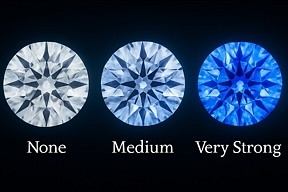
Fluorescence is a naturally occurring phenomenon that appears in certain minerals and gems. Some quality diamonds display a visible light when they are exposed to ultraviolet light. This light is known as fluorescence. Under most lighting conditions, a diamond's fluorescence is not visible to the naked eye, although the diamond will exhibit a soft colored glow if held under an ultraviolet lamp.
Do All Diamonds Fluoresce?
Not all diamonds fluoresce. If a specific diamond does not fluoresce, the grading report will list the diamond's fluorescence as either inert or none.
What Are The Different Types of Diamond Fluorescence?
The degree of fluorescence varies from faint to medium to strong to very strong. Faint means that the stone has a slight glow that is difficult to see under ultraviolet light. Very strong means that the diamond emits a deep glow that is very clear under ultraviolet light. The color of the fluorescence can also vary, although blue is the most common color. Yellow, green and white are other colors that a fluorescent diamond may exhibit.
How Does Fluorescence Affect A Diamond?
Fluorescence usually has no effect on a diamond's appearance in regular lighting conditions. In some cases, however, a strong blue fluorescence can make a yellow colored diamond appear whiter. In rare cases, it can cause a stone to appear milky or oily.How Does Fluorescence Affect A Diamond? Fluorescence usually has no effect on a diamond's appearance in regular lighting conditions. In some cases, however, a strong blue fluorescence can make a yellow colored diamond appear whiter. In rare cases, it can cause a stone to appear milky or oily.