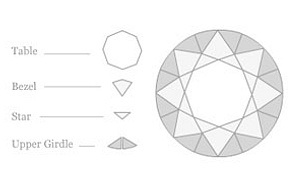
Diamond Cut
The cut of a diamond not only refers to the diamond’s shape, it also refers to how effectively the diamond returns light back to the viewer’s eye. A well-cut diamond will appear very brilliant and fiery, while a poorly cut diamond can appear dark and lifeless, regardless of its color or clarity. Not only do well-cut diamonds appear more brilliant, they also tend to appear larger than other diamonds of the same carat weight. An "ideal" diamond has both increased brilliance and diameter relative to more deeply-cut diamonds.
Ideal cut diamonds
An Ideal Cut Diamond is a round, brilliant, or princess cut diamond that is cut to ideal proportions and angles, and has excellent polish and symmetry ratings. An Ideal Cut Diamond is perfectly proportioned to refract light, producing that fire and brilliance up through to the table and crown. James Allen offers a nice selection of Ideal Cut Diamonds know at True Hearts™
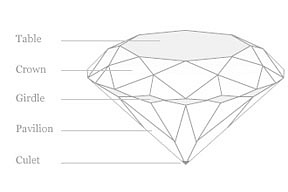
Hearts and Arrows True Hearts™
Seen from above, a Hearts and Arrows diamond shows an arrow pattern. When displayed on its pavilion side, the diamond presents the eye with 8 hearts with tiny 'v' shapes. Genuine Hearts and Arrows have these patterns visible at a single glance, indicating that the diamond has perfect optical symmetry. Our Hearts and Arrows collection are the ultimate expression of love - that's why we call them TrueHearts™. Every diamond from our TrueHearts™ collection is a lasting masterpiece, a perfect diamond.
Hearts and Arrows diamonds are sold under many names - Hearts on Fire and Leo Diamonds are two popular examples. At James Allen, we take pride in presenting only the finest Hearts and Arrows diamonds money can buy - every single TrueHearts™ diamond we sell is cut and polished at 100X magnification. Furthermore, our exclusive Diamond Display Technology™ lets you see any True Hearts™ diamond magnified in 360° so you can see exactly what you are getting.
Understanding Brilliance, Dispersion & Scintillation
A well-cut diamonds exhibit three different properties: brilliance, dispersion and scintillation. As light strikes a diamond's surface, it will either reflect off the table of a polished stone or enter the diamond. The light that is reflected off the diamond is known as the diamond's brilliance. As light travels through a stone, some of the light rays are separated into flashes of color. This is known as dispersion. The result of dispersion—the separation of white light into its spectral colors— is known as fire. Scintillation is flashes of color that are viewable as an observer moves a diamond back and forth.